How to make a bracket and crown a champion
A bracket pits contenders against each other, two at a time, until one is left standing. Nothing settles a "best of all time" argument faster, or starts a better one.
How a bracket works
This is single elimination: every matchup has a winner who moves on and a loser who goes home. Read it left to right, round by round, until only the final is left. Each round halves the field, so 8 contenders need three rounds and 32 need five.
Seeding decides who meets whom. Seed 1 is the favorite going in, and round one pairs the strongest with the weakest: in an eight-slot bracket that is 1 against 8, 4 against 5, 2 against 7 and 3 against 6. The favorites can only meet late, which is exactly what makes an early upset so satisfying.
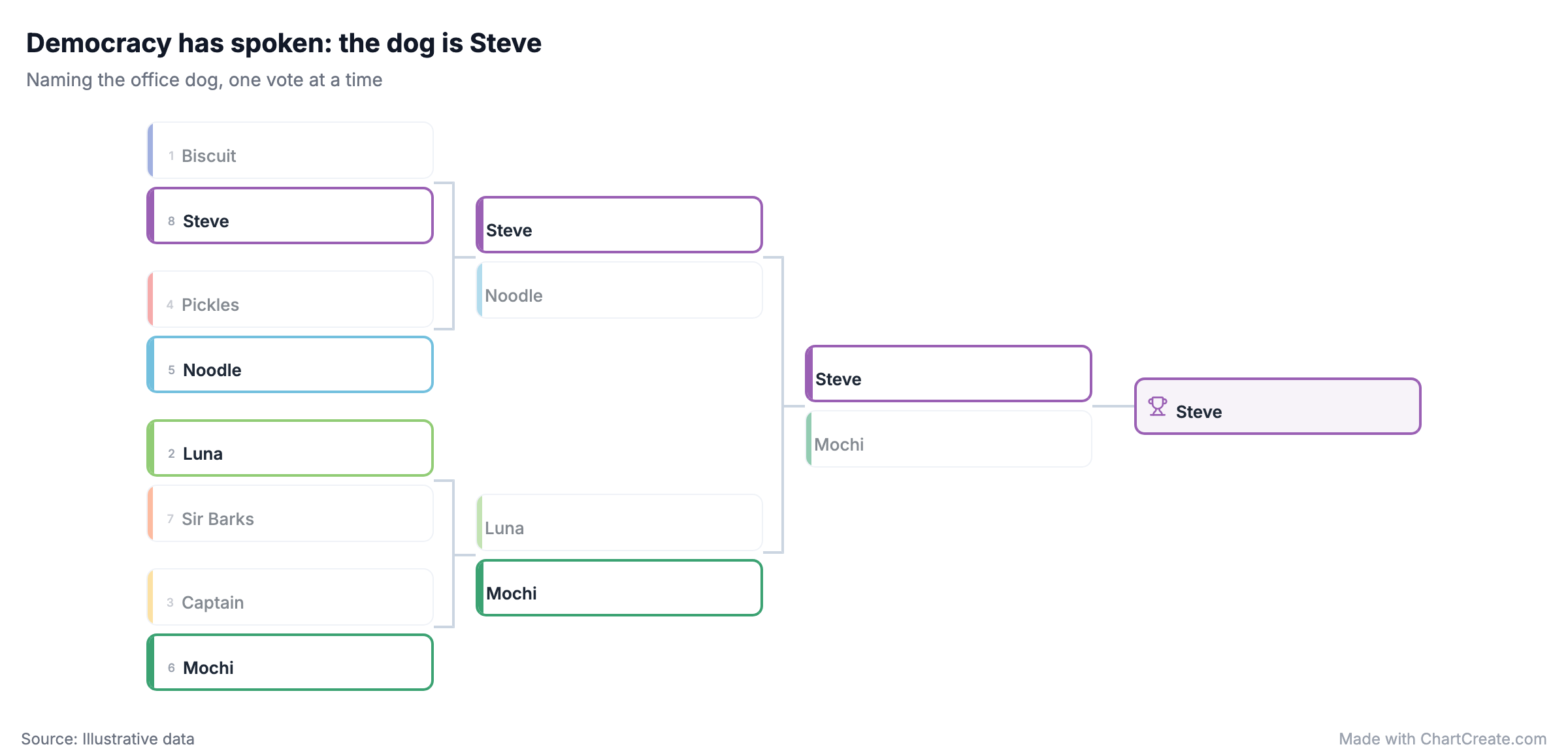
Follow Steve through the dog-name bracket. Seeded dead last, Steve knocked out top seed Biscuit in round one, got past Noodle in the semifinal, and beat Mochi, a sixth seed on an upset run of its own, in the final. As a list of results that is three lines. As a bracket it is a story with a beginning, a middle and a very confused dog.
Odd numbers and byes
A bracket wants a power of two: 4, 8, 16 or 32. With any other number, ChartCreate rounds up to the next size and hands the empty slots to the top seeds as byes, so they skip round one. The book club bracket has six genres in eight slots, which sends Mystery and Fantasy, seeds 1 and 2, straight through.
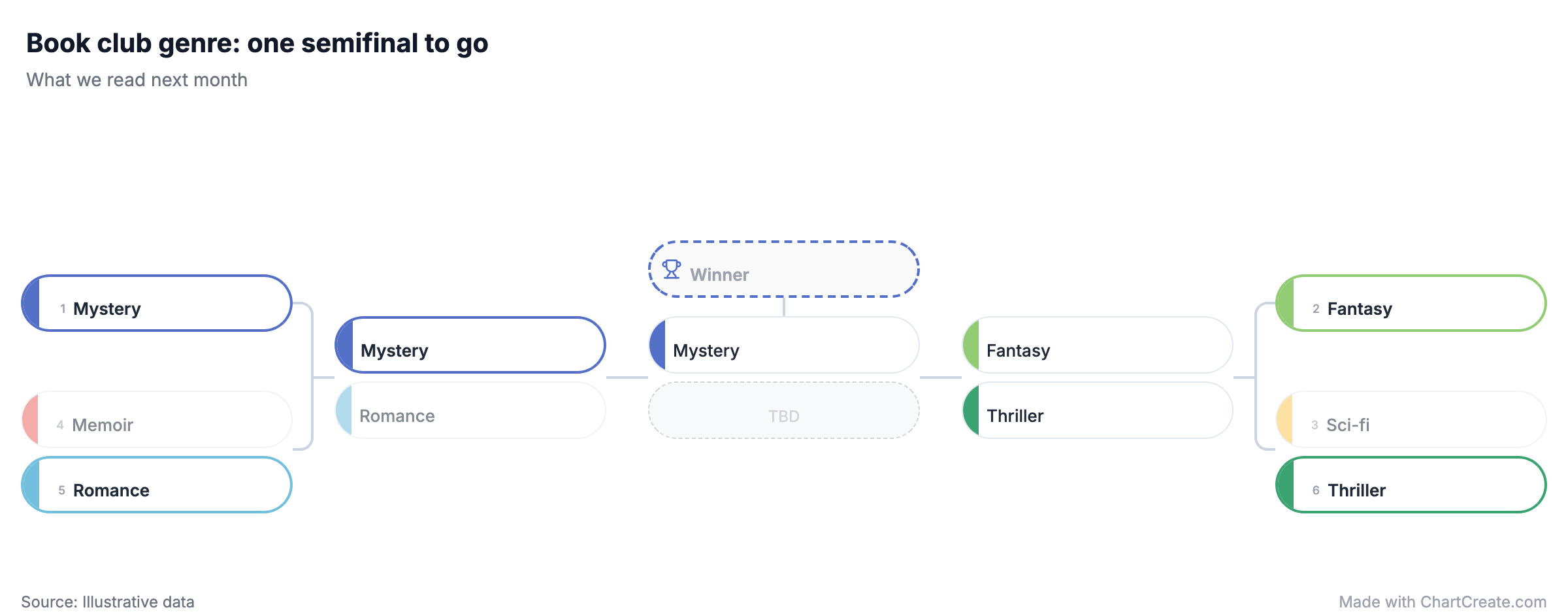
It also shows that a bracket does not have to be finished to be worth sharing. Mystery is already in the final, the other semifinal is still open, and every undecided slot reads TBD. Post it halfway through and let people argue about the rest.
When a bracket is the right chart
Use one when you want a single winner and a bit of drama on the way: a vote in a group chat, a community poll, or narrowing sixteen ideas down to the one you will actually build. A bracket is not a ranking, though. The runner-up may be the second-best entry, or simply the one with the luckiest draw. To rank everything, make a tier list; to show final scores or vote counts, use a bar chart.
Making one in ChartCreate
Add between 2 and 32 contenders in the Data tab and drag them to change the seeding. On the chart, click a name to send it through to the next round, and click the winner again to take the pick back. Hover a card to rename it or give it a picture, and Reset picks clears every result at once. The champion gets a card of its own, trophy included.
The Style tab sets the layout, one-sided or two-sided with the final in the middle, along with rounded, square or pill-shaped cards, straight or rounded connectors, and whether seed numbers show. Each contender takes a palette color by seed unless you give it a card color of its own. Download a PNG or JPG, in a square or portrait shape for social feeds. It is free with no account, and every image carries a small "Made with ChartCreate.com" credit.
A finished bracket also downloads as a reveal video. Choose Reveal video in the Download menu and the matches play out one at a time, round by round, until the champion drops in. It follows the winners you picked, comes as a video or a GIF, and has a 9:16 shape for TikTok, Reels and Shorts.
One common mistake: seeding at random. If the two favorites meet in round one, the final is an anticlimax. Keep names short, too. Cards get narrower as the bracket grows, and a long name shrinks and is eventually cut off.